Let\u2019s get something out of the way right now: if you\u2019ve spent the last few years feeling like the gaming industry had abandoned you in its relentless chase of live-service gold, you\u2019re not alone. I felt it too. Every conference seemed to announce another co-op shooter, another battle royale, another \u201ccontent pipeline\u201d designed to keep us logged in forever. But here we are in 2026, and a fascinating trend has only cemented itself: the majority of us simply prefer to play alone.
Back in 2024, MIDiA Research dropped a study that felt like a warm hug to many of us. It found that 53 percent of gamers prefer single-player games. Not a close tie with multiplayer, not a niche genre surviving on nostalgia \u2013 a clear majority. And that number hasn\u2019t exactly crumbled over the last two years. If anything, the resounding success of narrative-driven powerhouses like Grand Theft Auto VI in late 2025, which somehow balanced an online mode with a single-player epic so immersive that hours vanished like seconds, proved that we\u2019re still hungry for stories we don\u2019t have to share.
But who exactly makes up that 53 percent? The study sliced the data by age, and the results were a mirror of gaming lifecycles. For the youngest group, online PvP reigned supreme. And why wouldn\u2019t it? When you\u2019re a teenager or just into your twenties, the social battlefield of Fortnite, Call of Duty: Warzone, and whatever the latest multiplayer sensation is becomes your digital playground. It\u2019s where friendships are forged and trash talk is perfected. However, right around age 25, something shifts. The graph from MIDiA\u2019s research shows the lines crossing: single-player jumps into the lead as online PvP starts a steady decline in preference. By the time gamers reached 35 and beyond, single-player dominated by a wide margin.
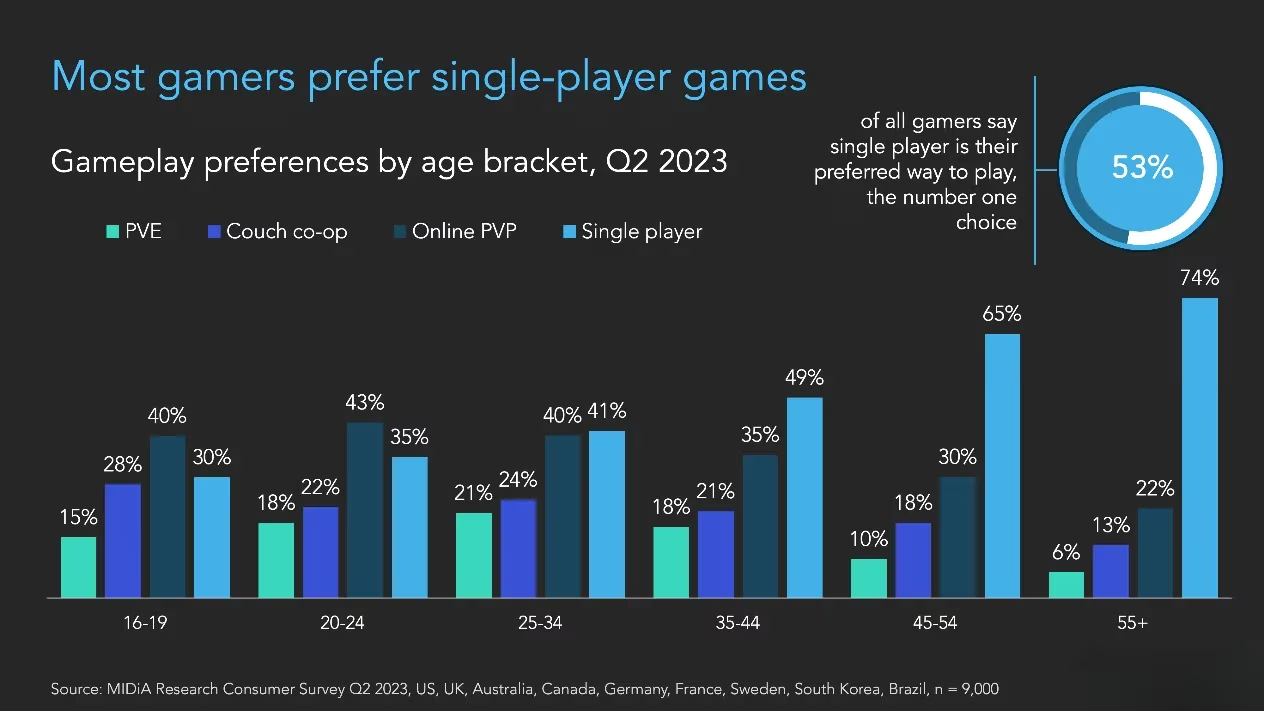
I\u2019ve been there myself, and I bet you have too. Remember when you could grind ranked matches for five hours on a Tuesday night with zero responsibilities? Now, after a long day of work or wrangling kids, the idea of jumping into a lobby with screaming strangers feels less like entertainment and more like a second job. We crave escape on our own terms \u2013 a world where we can pause, explore at a walk\u2019s pace, and not worry about letting down a squad. The data backs that up. The study spanned nine countries \u2013 the US, UK, Australia, Canada, Germany, France, Poland, Turkey, and South Africa \u2013 and gathered input from 2023 to 2024, so it wasn\u2019t a regional quirk. This was a global chorus of players saying, \u201cLet me lose myself in a good plot, please.\u201d
Given this, you\u2019d expect publishers to have course-corrected completely by now, right? After all, 2024 also gave us a vivid lesson in what happens when you ignore the single-player crowd. BioWare finally launched Dragon Age: The Veilguard ten years after Inquisition, a gap filled almost entirely by a failed attempt to build a multiplayer version of the franchise that got scrapped. Bethesda, once the holy temple of solo RPGs, fumbled with Fallout 76 before rediscovering a messy but undeniably single-player soul in Starfield. And who can forget the sobering flops of live-service projects that thought they\u2019d print money forever, only to shut down within months? The audience sent a clear message.
So here\u2019s the twist, and it\u2019s the reason I still see plenty of multiplayer-only announcements in 2026. MIDiA didn\u2019t just highlight player preferences; they pointed out the cold, hard financial reality. Microtransactions in live-service games remain the industry\u2019s real cash cow. A single-player title might sell 20 million copies and be a GOTY contender, but its post-launch revenue is often capped at a story expansion or two. A successful live-service game, on the other hand, is a perpetual money printer, generating income from cosmetics, battle passes, and seasonal content for years. A single whale can spend more than a hundred regular customers combined. So when a publisher looks at a game like Baldur\u2019s Gate 3 \u2013 a single-player masterpiece that shattered expectations \u2013 they obviously celebrate its success, but they\u2019re also salivating at the thought of that level of engagement attached to a storefront.
Does this mean we\u2019re doomed to a future of half-hearted solo modes tacked onto microtransaction vehicles? Not necessarily. What we\u2019re seeing now in 2026 is a smarter bifurcation. Some studios are fully leaning into their single-player DNA and thriving. Others are chasing the live-service dream but with a crucial understanding: the moment you force a multiplayer skeleton onto a single-player heart, fans can smell the rot instantly. The disastrous launch of a certain superhero squad game that tried to be a live-service shooter still echoes in boardroom meetings. The lesson isn\u2019t \u201cstop making single-player games\u201d; it\u2019s \u201cmake the game that fits the genre honestly, and don\u2019t expect to trade your soul for a quick skin sale.\u201d
For me, the real win is that we\u2019ve stopped debating whether single-player is dead. It isn\u2019t. It never was. The majority of us, especially as we get a few more candles on the cake, will always choose a rich, private world over a hyper-competitive lobby. The money might still whisper otherwise to executives, but the players have spoken, and we\u2019ve been loud enough to keep our adventures gloriously offline.