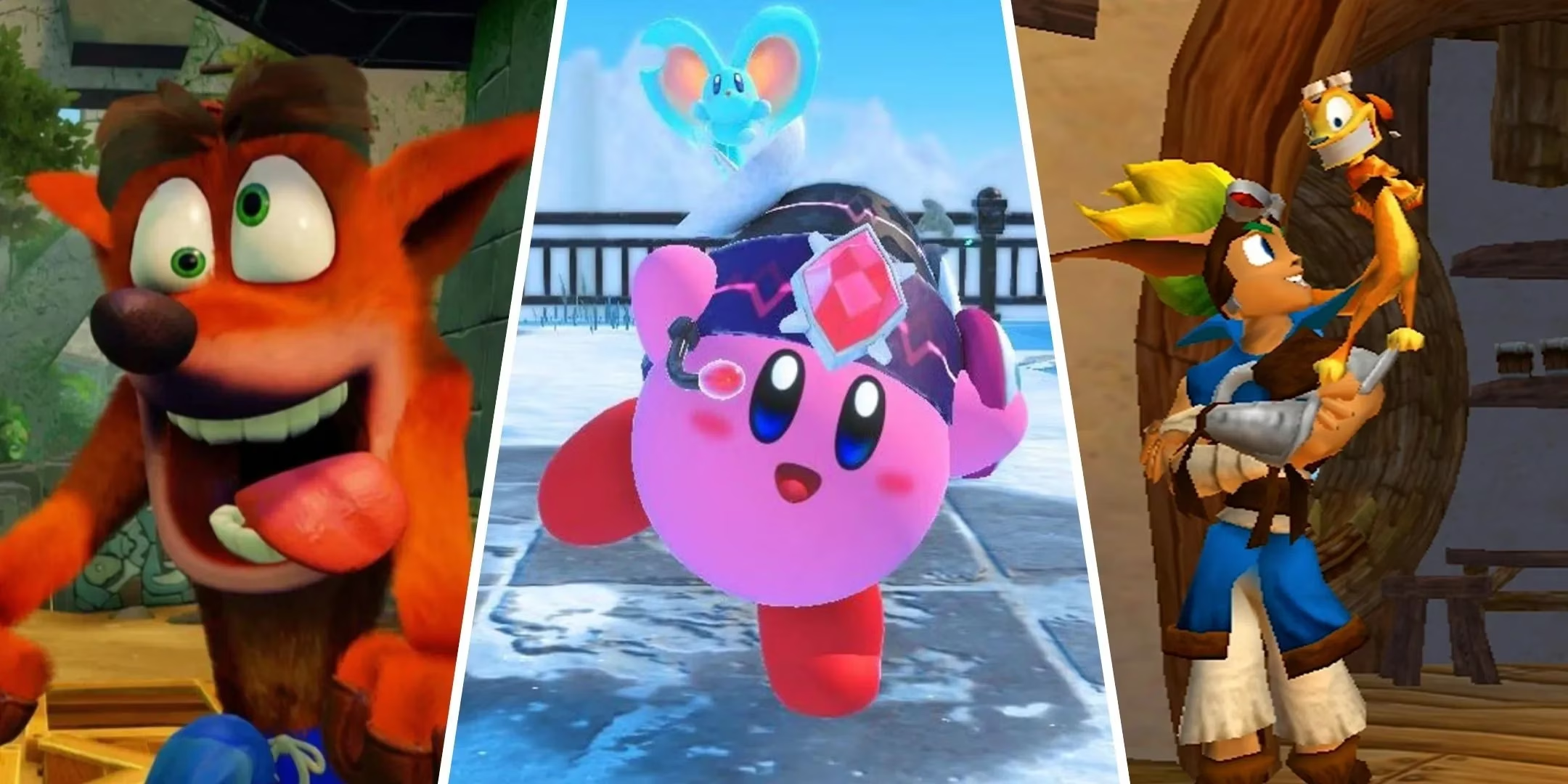
From the 8-bit era to the sprawling open worlds of 2026, video games have always been about delivering moments of pure, unadulterated joy. Whether it’s toppling a towering boss or simply snagging a shiny collectible, that surge of triumph demands an outlet—and what better way than a little celebratory dance? Some characters do it with swagger, others with adorable simplicity, but a select few have turned their victory shimmies into cultural touchstones. In a world where Fortnite emotes have infiltrated playgrounds and TikTok feeds, it’s worth revisiting the digital moves that started it all and the ones still keeping the party going. Here, then, are eight of the most iconic victory dances in gaming history—moves that have transcended generations and console cycles with their unmistakable flair.
Crash Bandicoot’s Hip-Thrusting Swagger
It’s impossible to talk about video game dancing without immediately picturing the orange marsupial’s brash, borderline-obnoxious routine. Across nearly every entry in the Crash Bandicoot series—right up to the most recent adventures in the mid-2020s—the character celebrates a job well done by thrusting his hips, framing his hands in ways that make parents do a double-take, and generally smirking at the player as if to say, “Yeah, I’m that good.” The dance has survived hardware generations, art-style shifts, and even a complete overhaul in the N. Sane Trilogy, where it was lovingly recreated with sharper polygons. What makes it so enduring isn’t just the humor—it’s that the animators packed an entire personality into a character who barely speaks. Every pelvic twist and self-satisfied head tilt amplifies the feeling that you, the player, have pulled off something genuinely cool. In 2026, speedrunners still delay grabbing the final gem just to let Crash do his thing; it’s a ritual that speaks to the dance’s strange, hypnotic power.
Kirby’s Timeless Tippy-Tap
On the opposite end of the attitude spectrum sits Kirby, the perpetually cheerful pink puffball whose victory jig has been warming hearts since Kirby’s Dream Land debuted on the original Game Boy. That primitive monochrome screen couldn’t even display Kirby’s signature color, yet the little dance—a simple back-and-forth sway paired with a tiny hop—was instantly recognizable. Over three decades and dozens of games, that dance has remained virtually unchanged, a soothing constant in a series that delights in reinventing itself around new copy abilities and massive gimmicks. Masahiro Sakurai and his teams have never messed with perfection; when Kirby clears a stage, you get the dance. In Kirby and the Forgotten Land, the first fully 3D mainline game, the animation was finally rendered from all angles, and it still felt exactly right. It’s the gaming equivalent of comfort food—no matter how rough a level gets, you know that a few seconds of Kirby’s gentle grooving will make everything okay.
The Original Ape Mayhem – Donkey Kong Country’s Gratifying Gesture
A “dance” might be overstating it, but Donkey Kong’s end-of-challenge animation from the original Donkey Kong Country on the SNES deserves a spot in the hall of fame for its sheer infectious energy. After finishing a bonus room or boss fight, the big ape breaks into a sequence that mixes a thumbs-up, a round of applause, and clasped hands raised overhead in victory. What makes it special is how DK stares straight at the camera while doing it—a direct, fourth-wall-breaking acknowledgment that you’ve triumphed together. The animation is miles more expressive than Diddy’s casual hat toss in the same game, and it perfectly set the template for the Rare-developed Kongs to be more than just platforming protagonists; they could be goofy, endearing, and unapologetically physical. Even today, that little bit of ape mayhem triggers a Pavlovian rush of satisfaction for anyone who grew up with the cartridge.
Diddy’s Boombox Beats – Donkey Kong Country 2: Diddy’s Kong Quest
If the first game’s celebration was understated, the sequel cranked everything up to eleven. Donkey Kong Country 2 gave Diddy Kong his own full-blown musical number at the end of every level, and it remains one of the most charismatic moments in the entire 16-bit library. Diddy spins his cap backward, dons a pair of sunglasses, and whips out a boombox that blasts a hip-hop-inspired beat. Then, as if that wasn’t enough, newcomer Dixie Kong materializes an electric guitar and unleashes a hair-metal riff that echoes through the jungle. It’s a perfect encapsulation of 1990s “attitude” without ever feeling forced, and the sheer detail crammed into those sprites—the way Diddy bobs his head, the glitter on Dixie’s strings—makes the sequence feel alive. Players revisiting the game through Nintendo Switch Online in 2026 still crack a grin at that first beat drop; some things never get old.
Super Mario RPG’s Adorable Party Shuffle
The Nintendo Switch remake of Super Mario RPG arrived in 2023 to a fanbase hungry for nostalgia, and the developers at ArtePiazza delivered a quiet masterpiece of celebratory animation. In the original SNES classic, leveling up a character simply meant a stat screen. The remake, however, turns every level-up into a tiny ensemble performance: the character who gained the stat boost strikes a dramatic pose while the rest of the active party shuffles in time to the background music. It’s a simple idea, but it transforms a mechanical moment into a burst of character. Mario does a little toe-tap, Mallow bounces with glee, and Geno—somehow—manages to look dignified while boogieing. By 2026, the game’s community has produced countless GIFs of these shuffles, proving that sometimes the best improvements are the ones that just make you smile. Honestly, every team sport should adopt this policy.
Jak & Daxter’s Power Cell Prance
Long before Jak II introduced guns and grim urban dystopias, the original Jak & Daxter: The Precursor Legacy on PlayStation 2 was a sun-drenched platformer about a boy and his ottsel buddy collecting power cells. The moment you grab one of those glowing MacGuffins, the duo launches into a short, perfectly choreographed celebration. Jak pumps his fist; Daxter pirouettes, moonwalks, and mugs for the camera like a miniature fuzzy egomaniac. It’s a snapshot of a more innocent era for the franchise, and for many fans, it remains the single most persuasive argument that the first game had the most heart. In 2026, with Jak and Daxter once again dormant, those few seconds of synchronized joy serve as a museum piece of a time when games weren’t afraid to just be happy with you for collecting a battery.
Fortnite’s Dance Moves – The Default Emote That Defined a Generation
It’s difficult to separate Fortnite’s cultural footprint from its emotes. The game’s vast library of dances has been the subject of lawsuits, schoolyard bans, and endless memes, but the one that started it all for many players is “Dance Moves”—the default celebratory taunt that pops up with your first-ever victory royale. Based on Turk’s famous running-man routine from the TV show Scrubs, the emote is equal parts nostalgic and endlessly quotable. Every elder millennial forced to explain the reference to a younger cousin experiences a tiny crisis. By 2026, nearly a decade after the battle royale exploded, the dance remains a rite of passage. New cosmetic emotes come and go, but that original set of steps still holds a mirror up to the game’s bizarre, joyful blend of pop-culture mashup and playground competition.
Sonic’s Chaos Emerald Quick-Step in Sonic Frontiers
Sonic the Hedgehog has always aimed to be the coolest mascot on the block, and even when the franchise leans into a more serious narrative, it can’t resist letting the blue blur strut his stuff. In Sonic Frontiers, every time Sonic collects one of the legendary Chaos Emeralds, he breaks into a snappy little quick-step accompanied by the mysterious, wobbling Koco creatures that populate the islands. It’s a blink-and-you’ll-miss-it flourish, but it carries all the self-assured swagger of a character who has spent three decades perfecting the art of looking effortless. The dance doesn’t just celebrate the player’s progress; it reinforces that, no matter how many titanic robots threaten the Starfall Islands, Sonic is still having the time of his life. In an era where many open-world heroes are grim loners, that cheerful footwork feels almost subversive—and absolutely essential.
These eight dances are more than cute easter eggs; they’re a shared language between developers and players, a tiny reward that says, “Great job—now here’s a few seconds of pure personality.” As games continue to chase photorealism and emotional depth, there’s something reassuring about knowing that somewhere, a bandicoot is still thrusting his hips after a job well done.